Component Configurator—When, for Whom, and How to Implement It
When is a component-based CPQ model effective in the manufacturing of machinery, trailers, and vehicle bodies? Mechanics, benefits, and implementation in a global dealer network.

Table of Contents:
- How Component-Based Configuration Works
- Speed and Consistency in Quoting
- Implementation example: agricultural machinery in a global network
- Frequently Asked Questions (FAQ)
- About EXSO
We previously described three CPQ configuration models —and noted that one of the most important steps in implementation is understanding the logic behind product creation and being able to map it to the CPQ system. This article explores the component-based model —its mechanics, benefits, and an example of its implementation across a global sales network.
How Component-Based Configuration Works
Component-based configuration involves building a product from ready-made modules and subassemblies selected from a catalog according to compatibility rules. The starting point is determining which elements can be used together, which are mutually exclusive, and which automatically require the selection of dependent components. The system enforces these rules, ensuring that only technically feasible variants are created from the available parts .
With a dozen or so components, the number of theoretical combinations quickly rises to the thousands, but only some of them are valid. Well-defined component logic narrows the selection down to variants that make sense from both a technical and commercial standpoint —and that is its essence: it organizes the space of possible product configurations.
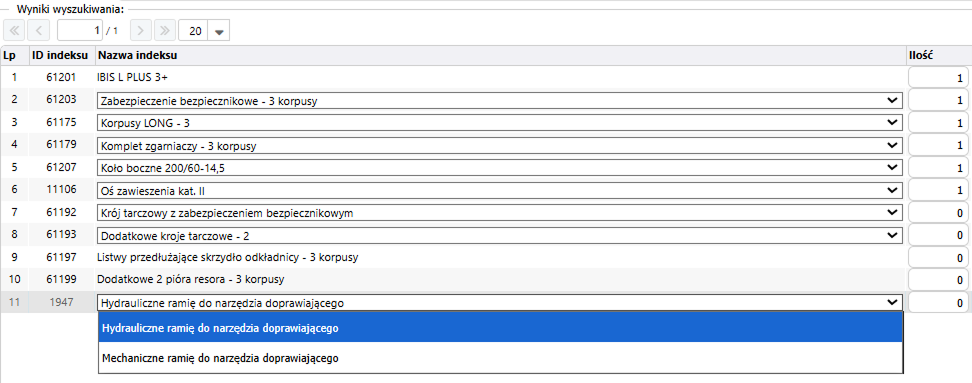
The component-based model works well for products that are assembled from a wide range of proven, off-the-shelf components. Examples include agricultural machinery, municipal equipment, trailers and semi-trailers, cabs, and vehicle bodies.
Implementing this type of product configurator model requires careful planning during the catalog and rule design phase, as well as the ability to add new elements to a system that is already in operation.
Speed and Consistency in Quoting
The biggest advantage of an online configurator based on a component-based approach is that it narrows down the range of options and automatically manages the dependencies between components.
The system guides the salesperson only through acceptable options —without the need to manually check whether the selected items are compatible. The quote is generated faster because most decisions have already been organized in advance.
The second benefit is consistency. The same product, configured by different people, generates a consistent, error-free quote regardless of the country of sale. Discrepancies between offers from individual sales representatives or dealers disappear, and the end customer receives a consistent proposal regardless of the sales channel.

The third benefit is seen in the sales network. Every dealer—even those in other countries—can configure the product on their own, without having to ask headquarters about the availability of variants or seek confirmation of technical accuracy. This significantly shortens the quoting cycle and frees the manufacturer’s technical team from repetitive questions that used to take hours each day.
The B2B component configurator also reduces the time it takes to onboard a new sales representative or dealer. Instead of having to master hundreds of technical rules and keep track of what goes with what, a new user goes through a structured selection process in which the system itself presents the available options. Product knowledge is stored in the configurator, not in the expertise of a few key individuals—the supplier creates it once, and engineers update it as needed.
A single, properly defined rule works equally well for engineers, salespeople, and partners—regardless of the breadth of the catalog or the size of the sales network
Implementation example: agricultural machinery in a global network
Agricultural and municipal machinery are classic examples of the component-based configuration logic used in industrial products. Municipal and agricultural equipment (sweepers, flail mowers, spreaders) consists of a set of modules designed to fit a specific vehicle and task. Each component requires appropriate mounting, a hydraulic system, and a power take-off (PTO) drive, and the CPQ configurator’s rules automatically block incompatible combinations.
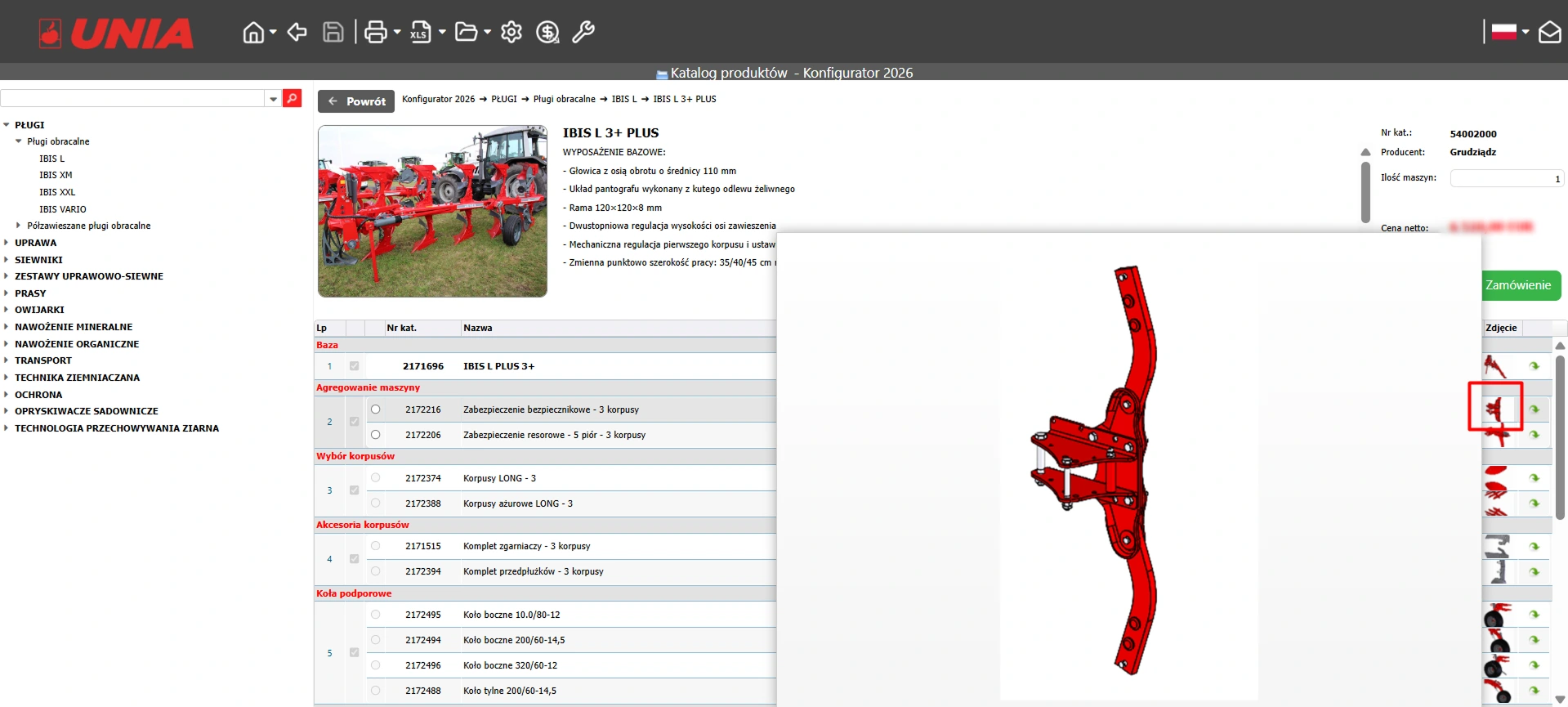
The scale of this approach is well illustrated by EXSO’s implementation for Unia— one of Poland’s largest manufacturers of agricultural machinery. The system enables the configuration of over 1,300 machines from approximately 65,000 components and options and supports a network of 520 dealers in 63 countries. Such an extensive catalog ensures complete configuration flexibility without the risk of errors.
The system automatically ensures the structural correctness of every configuration, and products, their components, and rules can be defined without programming. This demonstrates that well-defined component-based logic scales from a single machine to a global sales network.
See the Unia Portal project →
The three main functions of the component configurator:
- Automatic technical validation —the system only allows configurations that are structurally correct.
- Visual presentation of the product lineup —photos and drawings of each machine and component.
- Product and Parts Catalog – Defining industrial products, components, and rules without programming.
In this way, the component configurator organizes an extensive catalog and range—from a single product line to a global sales network.
Frequently Asked Questions
What is a product configurator?
A product configurator is a tool that allows you to select available product options in accordance with technical validity rules. It operates according to one of three logics: component-based (module selection), parametric (value calculation), or hybrid (a combination of both). It forms the core of a CPQ system for the industry.
What capabilities does the CPQ system offer?
CPQ (Configure, Price, Quote) is software that automates product configuration, pricing, and quote generation for complex products or solutions. Instead of manually creating quotes in spreadsheets, the system guides the sales representative or customer through the available options and generates a complete, accurate quote—often along with supporting documentation.
Is the component configurator a good fit for my product?
A component configurator is ideal when a product is assembled from ready-made modules and subassemblies selected from a catalog—without the need to recalculate parameters for individual orders.
If the portfolio consists of machines, equipment, trailers, cabs, or vehicle bodies, and every combination of components is predetermined and technically verified, the component-based model is the natural choice. When a product requires additional engineering calculations tailored to specific customer parameters, a parametric or hybrid model is the appropriate approach.
How long does it take to implement a product configurator?
Component-based configurations are the fastest to implement among the three quote configuration models. According to industry statistics, full CPQ implementations typically take 6 to 12 months. The time required depends on the complexity of the product, the readiness of the data for migration (descriptions, parameters, photos, etc.), and the involvement of the engineering team in designing configuration rules.
About EXSO
For over 17 years, EXSO (Expert Solutions) has been developing B2B platforms with sales configurators for large and medium-sized industrial manufacturers —including manufacturers of machinery, equipment, steel structures, air handling units, semi-trailers, and vehicle bodies.
What sets EXSO platforms apart is their scalability —ranging from solutions for sales teams to global dealer portals. EXSO platforms are based on industry-specific CPQ systems tailored to three configuration logics—component-based, parametric, and hybrid—and support multichannel sales, manufacturing, and warehousing processes.