Three Configuration Models in CPQ Systems with a Decision Tree for Manufacturers
Component-based, parametric, or hybrid CPQ configuration model? A decision map for selecting a system and criteria for evaluating an implementation partner for an industrial company.

Table of Contents:
- Why CPQ Is Transforming Sales in the Manufacturing Industry
- How Configuration Logic and Vendor Selection Drive Sales
- Component-based configuration model – a wide range of options, reliable results
- Parametric configuration model – a complete set from a single calculation
- Hybrid configuration model – flexibility of choice combined with computational precision
- Comparing Models and Choosing a Provider
- Decision Tree: Which Model Is Right for Your Product
- Frequently Asked Questions (FAQ)
Why CPQ Is Transforming Sales in the Manufacturing Industry
In the complex B2B environment, the speed and accuracy of pricing can be the deciding factor in gaining a competitive edge. Combined with product personalization, they enable you to create more tailored offers for customers. However, each variant must be priced, described, and verified for technical accuracy—a process that takes time, costs money, and requires the involvement of experienced specialists.
Product typology indicates whether a complex product is configurable (custom-assembled, ATO/CTO) or designed from scratch (ETO). This determines how production is managed and helps to preliminarily assess what sales support tool will be needed.
To speed up the quoting process and streamline sales, manufacturing and technology companies are increasingly investing in CPQ systems, viewing quoting efficiency as one of their key business metrics. The industrial sector is the largest adopter of these systems—accounting for 32% of the CPQ market in 2025 (Mordor Intelligence).
Today, large enterprises account for the largest share of the CPQ market (60% in 2025), having invested in the digitization of their sales processes for years. At the same time, the fastest growth in interest in CPQ solutions is being observed in the SME sector, where the market is growing at a CAGR of 17.85%.
The CPQ market is growing steadily—from approximately $3.63 billion in 2026 to a projected $7.55 billion in 2031 (CAGR of approximately 15.74%, 2026–2031). The biggest drivers of this growth are the shift to cloud-based solutions (+4.1% contribution to CAGR), the growing demand for sales efficiency (+3.2%), and multichannel sales (+2.8%).
This raises another, more important question: Can every system provider work with the logic that actually governs how a manufacturer’s product portfolio is formed? An implementation partner should have a thorough understanding of the specific nature of industrial products and select a configuration logic that accurately reflects the product’s manufacturing process.
How Configuration Logic and Vendor Selection Drive Sales
During the quoting process, an industrial product is created according to a specific configuration logic—through the selection of components, the calculation of parameters, or both methods simultaneously. The manufacturer does not choose the logic—it stems from the nature of the product. The logic behind silos, steel structures, or air handling units is embedded in the very structure of the product . The choice concerns the configuration model—that is, a specific type of configurator that accurately maps this logic in the sales system. Three models—component-based, parametric, and hybrid—correspond to the three basic logics.
This distinction has practical implications. Even the same product from two different manufacturers may require different mechanical designs. One manufacturer of warehouse racking systems assembles them from prefabricated frames, beams, and shelves according to compatibility rules. The other designs racking systems tailored to the specific loads and dimensions of the customer’s facility—calculating load capacity, height, and spacing.
A system tailored to the product’s logic shortens the path to a quote and drives sales exactly where it matters most. An ill-fitting system will solve half the problem and leave the other half to the salespeople.
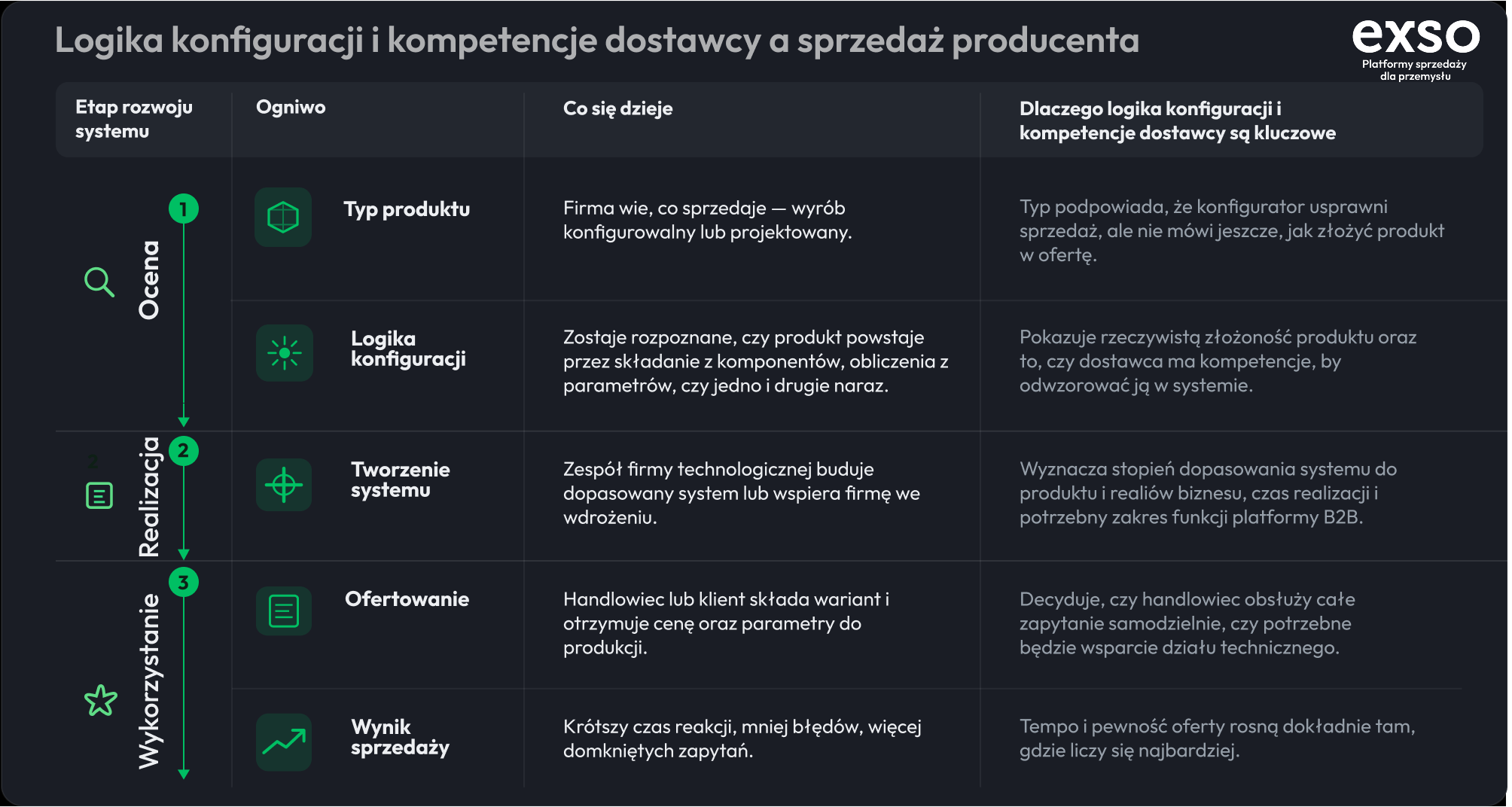
A team with experience in a given product class can capture the depth of the relationships between components, anticipate the evolution of the client’s portfolio, and design a rule structure that will remain viable for years of use. Without this expertise, the system will not be able to handle the actual complexity of an industrial product.
How do you choose a B2B platform provider with a configurator for a specific type of product, given that at first glance all systems look similar? Can the provider accurately map the product creation process within the system? That is precisely why the questions you ask the provider before making a decision are just as important as the choice of the model itself.
When choosing a vendor, the question “Can you create a configurator?” is too general —different vendors will answer “yes,” but they’ll mean very different scopes of capabilities.
Only two questions can provide a realistic picture of a sales configurator provider’s capabilities:
* How deeply can the system map the relationships between components?
* What experience does the team building it have with different configuration logics?
The three configuration models are based on component selection, parametric calculations, or a combination of the two. They are described below.
Component-based model—a wide range of options, reliable results
Component-based configuration relies on selecting off-the-shelf components according to compatibility rules. It works well for products assembled from modules, where every combination is predetermined. Examples include agricultural machinery, municipal equipment, trailers and semi-trailers, cabs, and vehicle bodies.
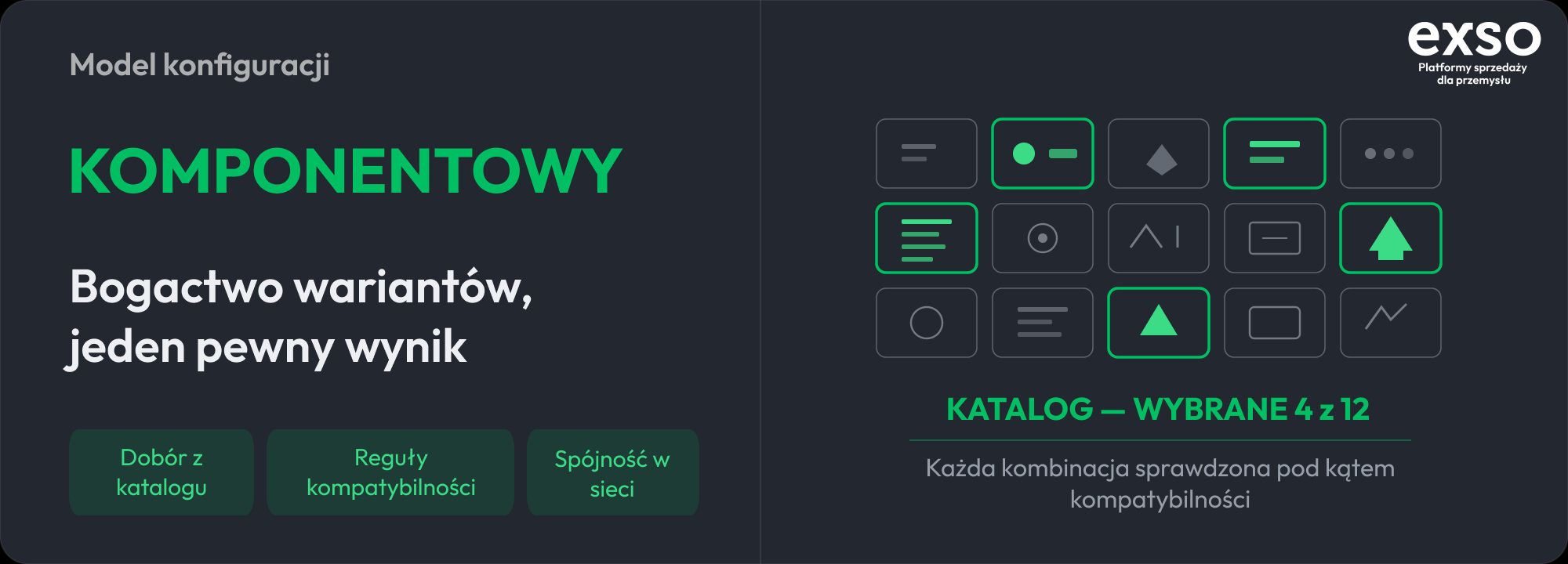
The advantage of this approach is the wide range of options it offers, which translates into actual sales effectiveness.
- A well-written catalog gives salespeople, dealers, and customers a great deal of freedom to customize it.
- System rules help organize complexity and make it possible to build a suitable product faster, more easily, and in compliance with technical standards.
- The manufacturer meets customer expectations without compromising production consistency.
A comprehensive overview with implementation examples → in the article “Component Configurator—When, for Whom, and How to Implement It.”
Parametric model—a complete set from a single calculation
Parametric configuration is based on formulas and technical relationships. The sales representative enters the input values, and the system calculates the dimensions, selects the materials, and determines the price. The parametric model is best suited for tanks, heat exchangers, air handling units, conveyors, and industrial brushes.
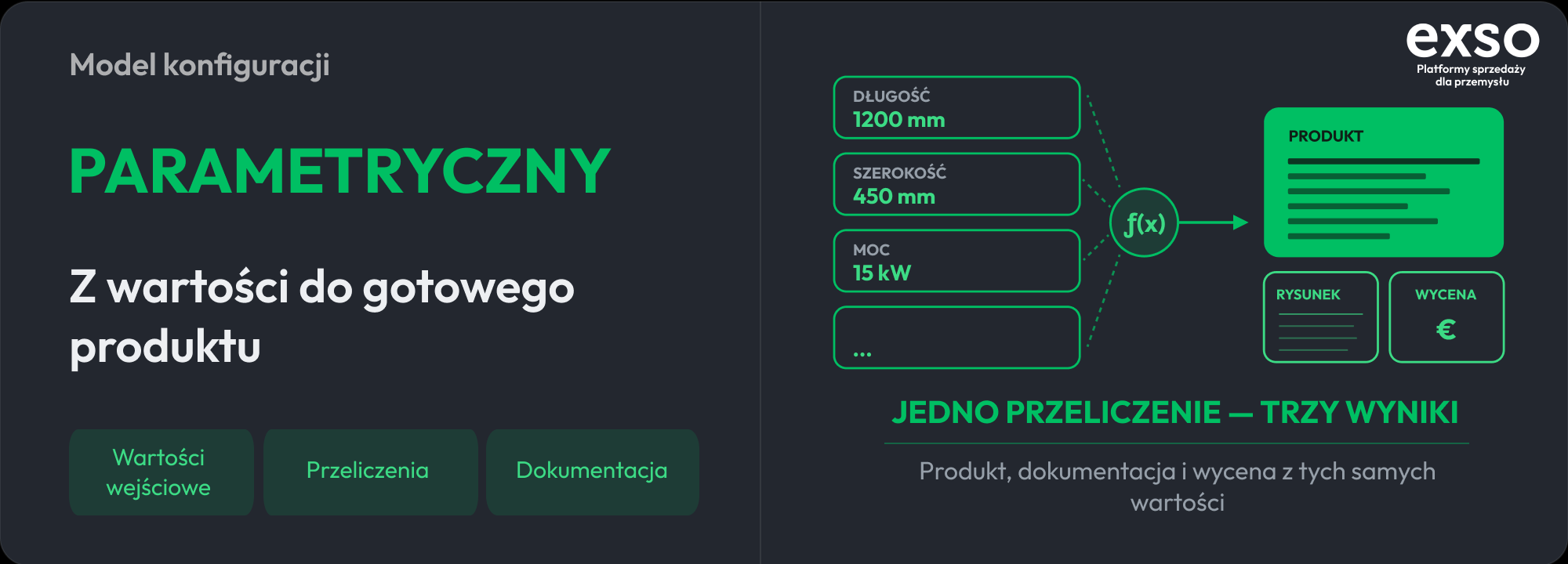
The advantageof this approach is that it allows the product to be precisely tailored to the requirements of a specific project.
- The customer receives a solution tailored to their specific needs.
- The system ensures engineering consistency, so every calculated product remains feasible.
- A single calculation generates a complete set of documents: a quote, technical specifications, and production data.
Hybrid model—freedom of choice combined with computational precision
A hybrid configuration combines component selection with parameter recalculation. Selecting a single component can trigger the recalculation of subsequent values, and the result of those calculations can determine which modules are even considered. Both processes then run simultaneously and are mutually dependent.
The hybrid model is suitable for steel structures, warehouses, silos, aluminum window and door frames, industrial doors, and cranes.
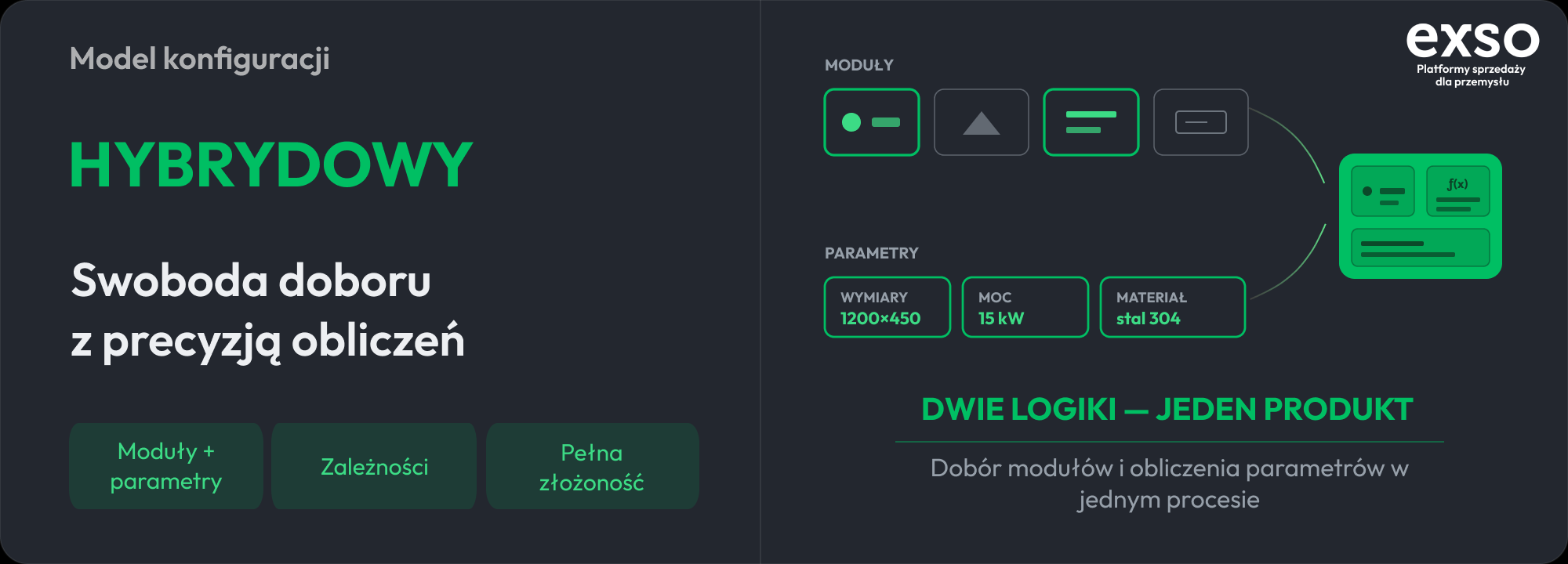
The advantage of a hybrid configuration is that it combines flexibility with precision in a single tool.
- The customer assembles the solution from ready-made blocks, yet still receives a product tailored to their specific requirements.
- The system manages all the complexity—both the selection and the calculations—so even a very complex object remains feasible.
- One tool replaces multiple separate tasks: variant selection and engineering calculations all take place in the same place.
Comparing Models and Choosing a Provider
The three configuration models differ in their starting point, the way the product is created, and the types of products for which they work best. Which configuration model should you choose? The table below outlines these differences and helps you easily match your product to the right model.
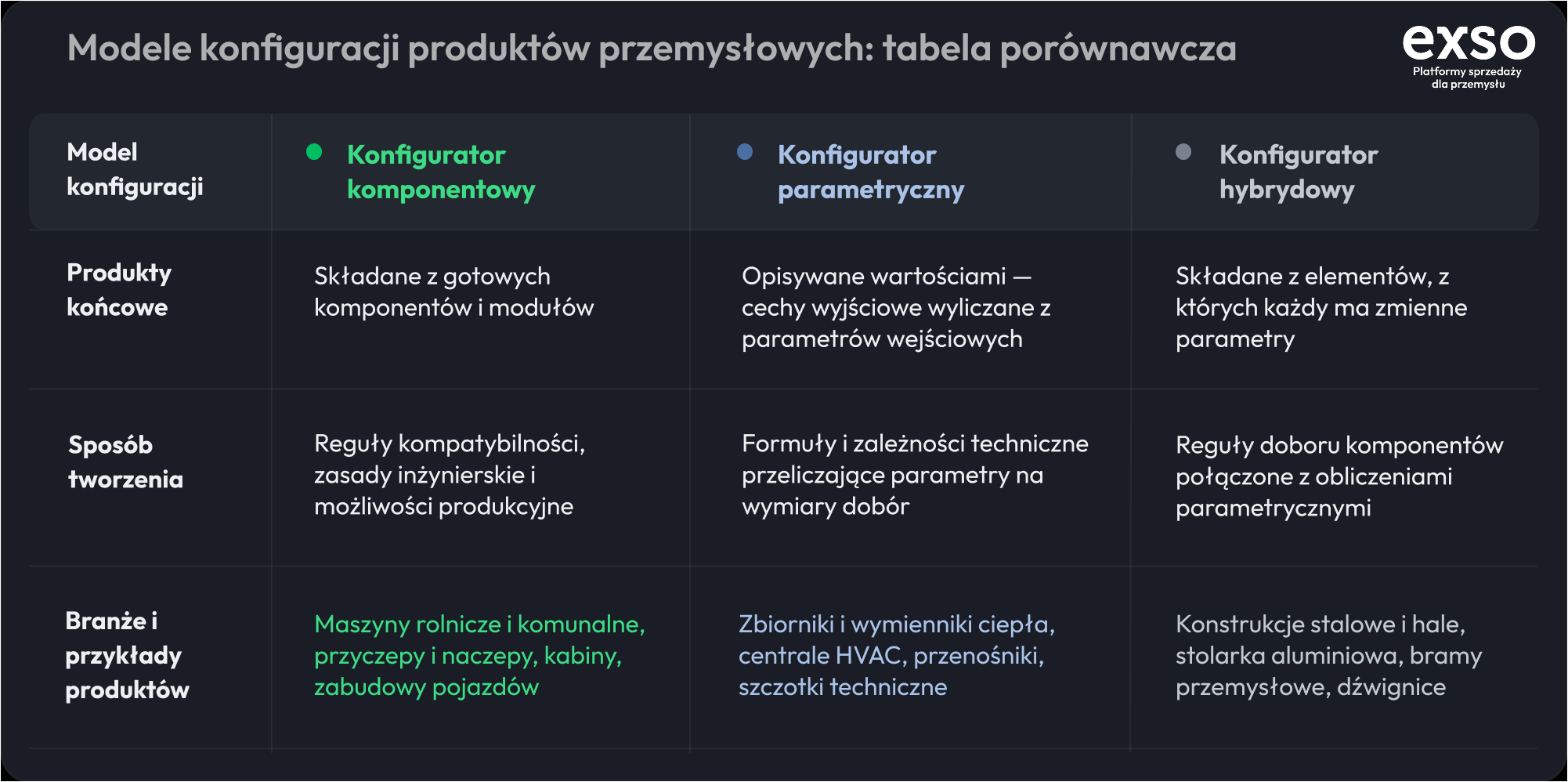
Regardlessof which logic is best suited to the product, a good system should be evaluated based on several consistent criteria:
- Fidelity to the product's logic— does the configurator accurately reflect the actual manufacturing process, including the depth of interdependencies between components?
- Comprehensiveness of the offering —does the system generate everything—quotes, documentation, and production data—without the need for manual input?
- Scalability – Can rules and new options be added without programming as the product lineup expands?
- Process integration —does the system integrate with ERP or CRM and fit into sales processes?
- Supplier experience – has the contractor already delivered products with similar functionality and complexity?
Thesecriteria are common to all three models—the only difference is that the more complex configuration logic places higher demands on each of them.
When choosing a configurator system, it's also important to consider the inherent characteristics of the implementation based on the logic.
- A component-based solution is the fastest to implement and scales along with the number of variants and sales channels.
- The parametric approach requires more work up front, but in return offers precision and automatic documentation.
- The hybrid approach is the most challenging to implement, but it covers products that a single logic couldn't fully handle— and it's most beneficial in situations where manual pricing previously took days of work.
See how the right configuration model can impact your company's sales results. → Schedule a call
Decision Tree - Which Model Is Right for Your Product
Whichconfiguration model is right for your products? The answer depends on a few diagnostic questions.
- How is a product created —by selecting ready-made components, by calculating values, or by doing both at the same time?
- Does changing a single parameter require recalculating other parameters —such as dimensions, weight, power, and material selection?
- Is there a list of the modules that make up the product, or is everything determined by the input values?
- Is the product a complex object consisting of several components, each with its own specifications?
The more responses indicate a selection from a catalog, the closer the model is to a component-based model. The more responses indicate calculations, the closer the model is to a parametric model. When both approaches are present, a hybrid model becomes the natural choice.
Frequently Asked Questions
How does configuration logic differ from a configuration model?
Configuration logic describes how a product is created—through the selection of components, the calculation of parameters, or both methods simultaneously. A configuration model is a specific type of configurator that implements this logic. The three models—component-based, parametric, and hybrid—correspond to the three basic types of logic.
How does a component-based configurator differ from a parametric one?
A component-based configurator assembles a product from ready-made modules selected from a catalog according to compatibility rules. A parametric configurator calculates a product based on input values—dimensions, performance, and operating conditions. The former answers the question “what fits with what,” while the latter answers “what values.” A hybrid configurator supports products that combine both mechanisms.
Which configuration model should I choose for a custom-made product?
The choice depends on how the product is manufactured. If it consists of ready-made components, a component-based model works well. If it requires engineering calculations, a parametric model is best. Complex products consisting of multiple devices or sections, each with its own parameters, are best handled by a hybrid model.
How does configuration logic differ from a configuration model?
Configuration logicdescribes how a product is created—through the selection of components, the calculation of parameters, or both methods simultaneously. A configuration model is a specific type of configurator that implements this logic. The three models—component-based, parametric, and hybrid—correspond to the three basic types of logic.
How long does it take to implement a product configurator?
The time requireddepends on the configuration logic and the complexity of the product. Full CPQ implementations typically take 6 to 12 months and require specialists. Configurations based on component logic are implemented more quickly, while those based on hybrid logic take the longest. The vendor’s experience in implementing products with similar logic is the biggest factor in reducing this time.
What configuration models does EXSO use?
EXSO builds configurators using all three approaches—component-based, parametric, and hybrid. EXSO’s projects include a portal for an agricultural machinery manufacturer (component-based), a configurator for industrial brushes with production documentation (parametric), and a system for agri-food facilities that combines both approaches (hybrid).
About EXSO
For over 17 years, EXSO (“Expert Solutions”) has been developing B2B platforms with configurators for large and medium-sized industrial manufacturers —including manufacturers of machinery, equipment, steel structures, air handling units, trailers, and vehicle bodies.
EXSO portals are based on CPQ systems tailored to three approaches to building complex products: component-based, parametric, and hybrid. This supports multichannel sales and international expansion plans.
What sets EXSO platforms apart is their scalability—from solutions for sales teams to global dealer portals.