CPQ Systems for Manufacturers: Benefits, Selection, and Implementation
88% of manufacturers lose at least one deal due to manual quoting and sales processes, resulting in an average annual loss of 5% of revenue. The COO of a company that manufactures complex machinery and equipment is all too familiar with this scenario: hundreds of variables, days of coordination, and the risk of an error that could cost a margin or an order. The solution lies in Configure, Price, Quote (CPQ) systems—the choice of the fastest-growing industrial manufacturers.

Table of Contents
- How effective is standard pricing—where does time and profit margin really slip away?
- What is a CPQ system and how does it work in practice?
- Standard Quoting vs. CPQ System – What Really Changes
- 5 Key Operational Outcomes Following CPQ Implementation
- What should you look for when choosing a CPQ system?
- How does CPQ integrate with ERP and CRM systems?
- Summary
- Frequently Asked Questions
1. How effective is standard pricing? Where exactly do time and profit margins slip away?
Manufacturers of complex custom-made machinery and equipment have been facing the same bottleneck for years: the quoting process is slow, costly, and prone to errors. A sales representative or dealer gathers requirements, verifies technical details, works out a quote with a manager, organizes the information, compiles it into a proposal, and returns to the customer—who, in the meantime, has already spoken with three competitors. The result is a delay that costs the contract—or the margin, if the calculation contains an error or the sales representative saves the deal by making price concessions.
The traditional bidding process in industrial manufacturing relies on tools with two levels of sophistication.
- Basic – relying on spreadsheets for price lists and cost estimates, Word or PDF templates for quotes, and email as the primary channel for coordination between departments.
- advanced – featuring an implemented CRM system for managing sales opportunities, a quoting module within the ERP system, technical documentation in product data management systems (PLM or PDM), and dedicated cost estimation spreadsheets.
The question is, do the bidding tools work together?
A sales representative retrieves data from the ERP system, transfers it to a spreadsheet, consults the specifications with an engineer via email, waits for a cost estimate from the manager, drafts a proposal in a word processor, and sends it through the CRM. Every transition between systems introduces another risk of error, more hours of waiting, and a lost competitive edge to a competitor who responds faster.
A survey of 200 B2B decision-makers in the manufacturing sector (Aleran / TrendCandy, 2025) illustrates the scale of the problem.
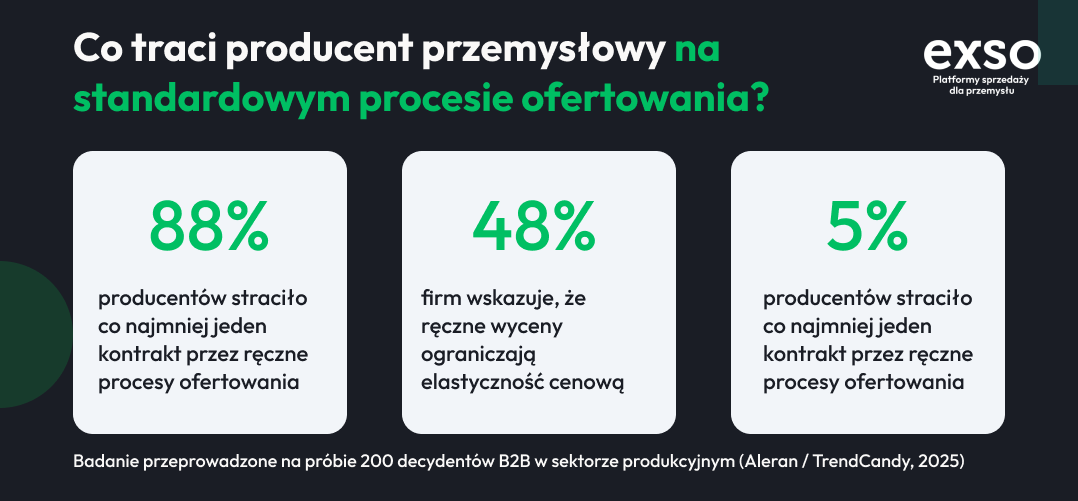
More than 72% of B2B companies manage over a thousand configurable product combinations. Each order is a combination of technical specifications, materials, dimensions, additional options, and delivery terms. In such an environment, quoting based on disparate tools is a constant source of risk—incorrect specifications, outdated component prices, and inconsistencies between the quote and technical documentation.
The problem is structural: the products are too complex to price intuitively, yet too unique to rely on off-the-shelf price lists. We need a tool that allows us to achieve better operational results with the same team.
2. What is a CPQ system and how does it work in practice?
CPQ stands for Configure, Price, Quote. It is a category of business software that automates and standardizes the entire process of preparing commercial quotes for configurable and complex products.
According to MGI Research, the largest investors in CPQ software include industrial machinery manufacturers, the automotive industry, and the technology sector —specifically hardware, software, and peripherals. Systems of this type are also being implemented by growing manufacturers of heavy equipment, packaging and processing machinery, power generation equipment, and electronic components. For these companies, CPQ has become an operational tool that directly impacts response time to inquiries, the cost of preparing a quote, and the quote conversion rate.
The CPQ system operates across three interconnected layers:
- Configuration - the product rule engine guides the user through a series of technical choices, eliminating combinations that are impossible or do not meet the specifications. Sales representatives or dealership partners can configure the product on their own—without having to involve engineers for every inquiry.
- Pricing - The portal automatically calculates prices based on configuration, current component costs, margins, channel discounts, and pricing rules for specific markets. This eliminates the need for manual cost estimation and the risk of outdated data.
- Quote - the system generates complete quotation documentation: technical specifications, price lists, and terms and conditions—in the selected language and format, ready to be sent to the customer.
Integrated with ERP, CRM, and invoicing systems, CPQ closes the loop from product configuration all the way to the production order—reducing errors, shortening lead times, and directly improving the company’s operational and financial performance.
Despite growing awareness, only 37% of B2B manufacturers have fully automated their quoting processes—nearly two-thirds still handle them at least partially manually (Aleran / TrendCandy, 2025).
In advanced B2B portals, the CPQ system integrates with a 2D/3D product visualizer, a technical documentation management system, and an approval module—creating a comprehensive engineering sales environment. CPQ systems are also increasingly serving as self-service portals for dealers and distributors—partners configure and price products on their own, 24/7, without involving the manufacturer’s internal resources.
3. Standard Quoting vs. CPQ System – What Really Changes
The difference between a typical process based on separate tools and an integrated CPQ system is not a matter of technology. The key difference lies in the fluidity of operations, data accuracy, and background synchronization—which translates into advantages in response time, margins, and scalability.
Standard quoting depends directly on sales representatives in each market—it requires manual data adjustment and involves headquarters staff or internal specialists for every inquiry.
Quoting with the CPQ system is based on centralized rule management, which dealers and sales representatives in various regions use independently—always with up-to-date data.
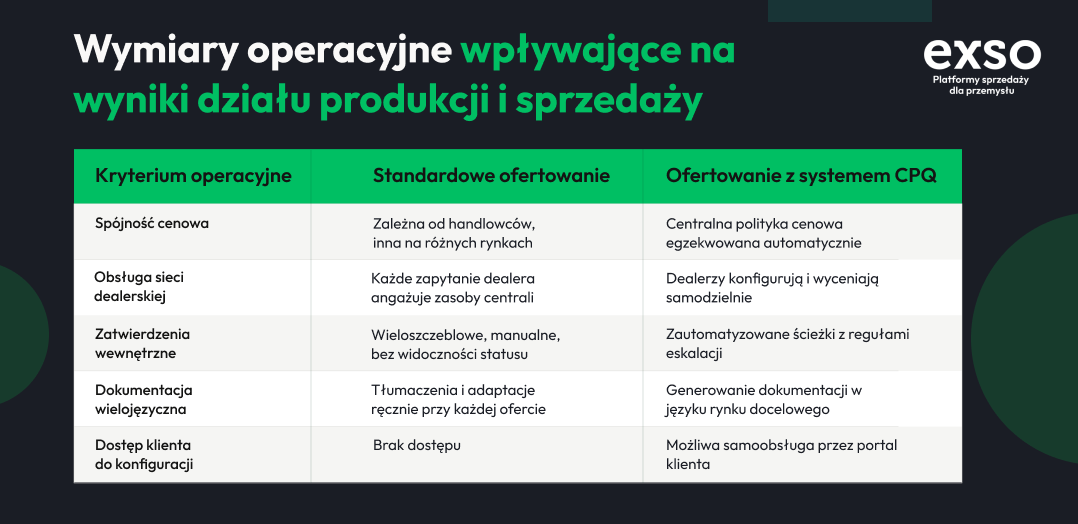
What sets CPQ apart from a spreadsheet or a CRM module is that the product logic is defined once—and enforced automatically for every configuration. The system "knows" which components are mutually exclusive, what standards apply in a given market, and how changing a single parameter affects the total price. In a typical process, such a check is performed manually each time.
4. 5 Key Operational Outcomes Following CPQ Implementation
Implementing CPQ delivers measurable benefits—in terms of time, money, and the quality of customer relationships. Here are the most important ones:
- Reducing query response time
- Correction of technical errors
- Scalability without a proportional increase in costs
- Data integration—from quote to production order
- Freeing the technical department from sales duties
Reducing query response time
The time required to prepare a quote is significantly reduced. With 71% of companies admitting that a single quote takes at least a full workday (Aleran / TrendCandy, 2025), any reduction in this time directly translates into sales results: manufacturers who respond to inquiries first have a higher win rate—regardless of price. A sales representative or partner can handle significantly more inquiries without expanding the team.
Correction of technical errors
According to a 2025 study by Aleran / TrendCandy, 44% of manufacturers cite errors in manual data entry as the direct cause of lost orders. An error in an order detected during fulfillment costs many times more than an error detected during configuration. The CPQ rules engine enforces product logic during every configuration—incorrect combinations are impossible, and orders sent to production are complete and correct—the first time.
Scalability without a proportional increase in costs
In the standard model, any increase in inquiry volume requires a proportional increase in sales and technical support resources. The configuration portal decouples volume from service costs: the dealer network manages itself, while headquarters manages rules and pricing policies—not individual offers. This is essential for the true scalability of local and international expansion.
Data integration—from quote to production order
An approved configuration automatically generates a production order in the ERP system—without the need to manually transfer data between systems. This eliminates one of the most costly issues in made-to-order manufacturing: the discrepancy between what was quoted and what is actually produced. A single source of truth for sales, operations, and production.
Freeing the technical department from sales duties
In the standard process, engineers are involved in every non-standard inquiry—as feasibility validators and cost estimators. After the configurator is implemented, their knowledge is embedded in the system’s rules and available to every sales representative without direct involvement. The technical department regains time for product design and development. Additionally, product knowledge is no longer confined to a few key individuals and becomes an organizational asset rather than an individual one.
When should a manufacturing company consider implementing CPQ? There is no single point at which the system becomes essential, but specific operational indicators clearly signal that it is worth exploring this option.
Ask our experts for the checklist titled “Readiness Indicators — When Does CPQ Implementation Make Operational Sense?”
5. What should you look for when choosing a CPQ system?
The CPQ market is vast— ranging from global enterprise solutions to specialized systems for industrial manufacturers. Choosing a CPQ system is a matter of ensuring it fits the operational context: product complexity, market specifics, and sales model.
When evaluating a specific solution, it’s worth considering five criteria.
- System scope - sales platform vs. ERP module
- Licensing model
- The Power of Configuration Rules
- Architectural scalability
- Implementation model and go-live date
System scope - sales platform vs. ERP module
CPQ systems fall into two categories: specialized sales platforms designed for the quoting process and partner networks, and modules built into ERP systems.
ERP modules offer deep integration with production data, but often have limited configuration options and a less robust interface for dealers. Specialized platforms are more flexible in terms of product logic and partner network management—and integrate with ERP systems via APIs.
Licensing model
It’s worth checking whether the license fee:
- is independent of the number of users and partners,
- does not increase with the number of configurable products in the catalog,
- does not grow proportionally with the expansion of the dealer network.
For a manufacturer planning to expand internationally, a flat-rate model offers cost predictability—a per-user model can generate unexpected costs with every new dealer or market. It’s also worth asking about support for multiple currencies and languages in documentation—for an exporter, this is a requirement, not an option.
The Power of Configuration Rules
This is the heart of every CPQ system. The more complex the product logic—including dependencies between components, exclusions, and technical conditions—the more critical the quality of the engine becomes. The system should support multi-level configurations with nested rules, not just simple variants from a list.
Architectural scalability
A good solution grows alongside the company. An implementation that starts with a configurator should allow for the later addition of service, logistics, or dealer portal modules—without the need to migrate to a new platform. The key question is: Can the system support a multilingual dealer network across different countries without requiring separate implementations for each market?
Implementation model and go-live date
The typical implementation timeframe is 3–9 months. It’s worth asking about the resources required on the client’s side, how the product database is updated following changes to the product lineup, and the availability of support after launch. Phased projects—starting with the configurator and followed by integration with ERP—reduce the time to see initial results.
Learn about the factors that EXSO’s Chinese partner considered when selecting a European technology partner.
6. How does CPQ integrate with ERP and CRM systems?
Integrating the configuration and pricing platform with ERP and CRM systems is one of the key factors for a successful implementation—because it determines the speed and efficiency of every operation in the quoting process. Here’s what the data flow looks like in a manufacturer’s mature digital ecosystem:
- CRM → CPQ: Customer data and sales opportunities from the CRM are transferred to the CPQ system, where a sales representative or dealer begins configuring the product for a specific transaction.
- ERP → CPQ (master data): The CPQ platform retrieves up-to-date data from the ERP system regarding components, material availability, and production costs—ensuring accurate pricing.
- CPQ → ERP (order): Once the quote is accepted, the approved configuration automatically generates a production order or BOM (Bill of Materials) in the ERP system—without the need for manual data entry.
- CPQ → CRM (quote history): All generated quotes, configurations, and customer decisions are saved in the CRM, building a relationship history and enriching the sales team’s analytical data.
In advanced implementations, data flows in both directions in real time—changes in inventory levels or component pricing in the ERP system immediately update the pricing options in the configuration portal. Above all, CPQ integration with ERP eliminates one of the most costly issues in made-to-order manufacturing: the situation where a customer receives a quote based on outdated cost data or unavailable components.
Summary
Quoting for complex products is one of the most costly processes in a manufacturing company—and one of the most underrated areas for optimization. Implementing a CPQ system is not just about streamlining the process—it’s a fundamental shift in how the entire sales organization operates.
A change that everyone is feeling:
- Sales teams configure products quickly and confidently—quotes are technically accurate, pricing is precise, and response times to inquiries are significantly reduced.
- Partners and dealers make their own offers in their own language, currency, and according to local pricing conditions—without having to submit inquiries to headquarters.
- Customers receive tailored, comprehensive quotes in the shortest possible time—which directly impacts their shopping experience and their decision on which supplier to choose.
- Operations managers gain processes that keep pace with the scale of expansion—without a corresponding increase in operational costs or the risk of error.
For manufacturers of complex machinery and equipment that operate a multi-channel sales strategy and are planning to expand internationally, CPQ systems are becoming a game-changer.
Frequently Asked Questions
Does CPQ replace an ERP system?
No—CPQ and ERP serve complementary functions. ERP manages a company’s operational data: assets, production, finance, and the supply chain. CPQ specializes in the sales process: product configuration, pricing, and generating proposal documentation. Both systems deliver the greatest value through integration—data from ERP feeds into pricing in CPQ, and the approved configuration is returned to ERP as a production order.
How long does CPQ implementation take, and what does it require from our team?
The typical implementation timeframe is 3–9 months, depending on the complexity of the product offering and the number of integrations with existing systems. On the client side, the involvement of three key departments is essential: the technical department—to map product rules; the sales department—to define pricing and discount logic; and the IT department—to integrate with ERP and CRM systems. Phased projects allow for initial results to be achieved as early as 2–3 months.
What types of companies would benefit from CPQ?
A configuration and pricing system delivers the greatest value to companies that sell configurable or custom-designed products—where each order is a combination of technical specifications, variants, and delivery terms. It works particularly well for manufacturers conducting multi-channel sales through a dealer network, active exporters serving several markets simultaneously, and companies where the response time to a request for quotation directly impacts business results.
How does CPQ impact the work of the engineering department?
In the standard process, engineers are involved in every non-standard inquiry—acting as feasibility validators and cost estimators. After implementing the configurator, their expertise is embedded in the system’s rules and available to every sales representative without direct involvement from the technical department. Engineers regain time for product design and development. Additionally, product knowledge is no longer dependent on specific individuals—it becomes an organizational asset available to the entire team.
Where to start—what’s the first step in implementation?
The starting point is usually an audit of the current quoting process: how long it takes to prepare a quote, where errors most often occur, how the dealer network is managed, and what systems are already in place at the company. Based on this, the platform provider can determine the scope of the implementation, the go-live timeline, and the expected operational results. Most initial discussions with CPQ providers are consultative in nature and do not obligate the client to purchase.
About Us
For over 17 years, EXSO has been developing B2B sales platforms with CPQ configurators for large and medium-sized manufacturers. The team specializes in automating the quoting process for complex industrial products—reducing response times to inquiries and minimizing the role of engineers in day-to-day sales operations.
We’ll help you assess the potential benefits of implementing a CPQ system in your company —during a free consultation with our expert.
Schedule a free consultation with an EXSO expert