B2B Industrial Products – 3 Types and the Technology That’s Transforming Sales
Do you know which category your product falls into? Discover the three models, their pricing logic, and the tools that can transform your sales—including the CPQ configurator.

Manufacturers differ not only in what they produce, but above all in how they design their products and how they respond to customer needs. The same is true in the industrial machinery, automation, HVAC, valves, packaging, and transportation systems industries. In each industry, three main types of products can be identified, and each follows its own logic.
If we take a look, for example, at the agricultural machinery industry, we’ll see that at a trade show, the following are all side by side:
- a manufacturer of standard sprayers available immediately from the catalog,
- a manufacturer of modular sprayers that can be configured with a boom, tank, and pump according to customer specifications, and
- a manufacturer of sprayers custom-designed to meet the specific needs of individual farms.
One industry, the same customers—and three completely different approaches to the product and sales.
Most manufacturers have a keen sense of this in practice. However, they rarely state it explicitly—and it is precisely this explicit recognition that allows us to see what can be improved in a given model.
Three types of products—how they differ and where each one shines
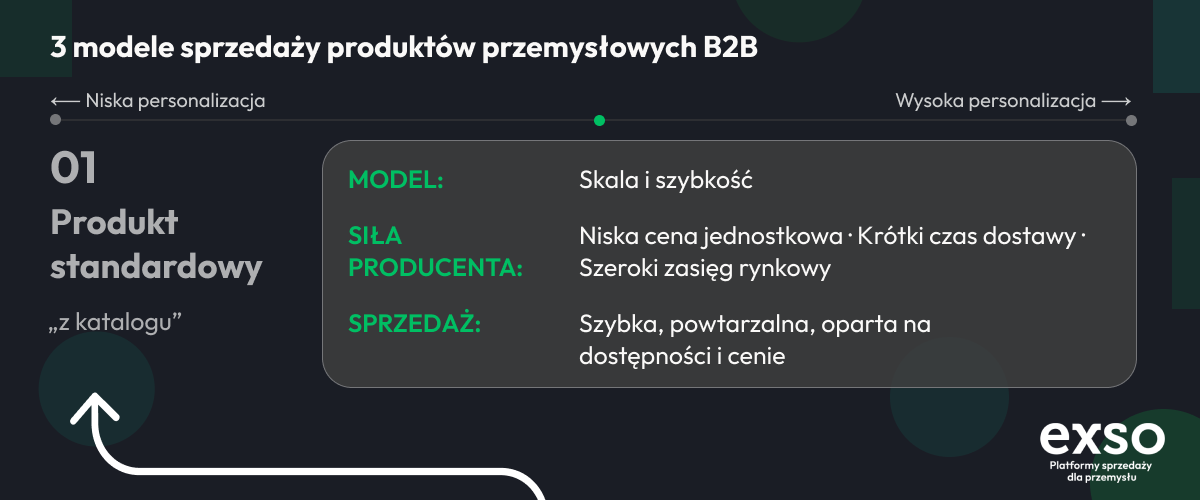
Type 1 - Standard product
Before a customer submits an inquiry, the standard product (📦 Make-to-Stock (MTS) already exists. It is described in the catalog, has fixed specifications, a set price, and stock availability. The selection process simply involves choosing an item from the ready-made catalog—without negotiating specifications or involving the designer.
The first model is based on scale and speed. The manufacturer’s strengths here are mass-production efficiency, streamlined logistics, and wide distribution. Sales are straightforward and repeatable—what matters is availability, price, and delivery time.
Examples: standard hydraulic fittings, fasteners, off-the-shelf pumps, simple agricultural trailers.
Type 2 - Customizable product
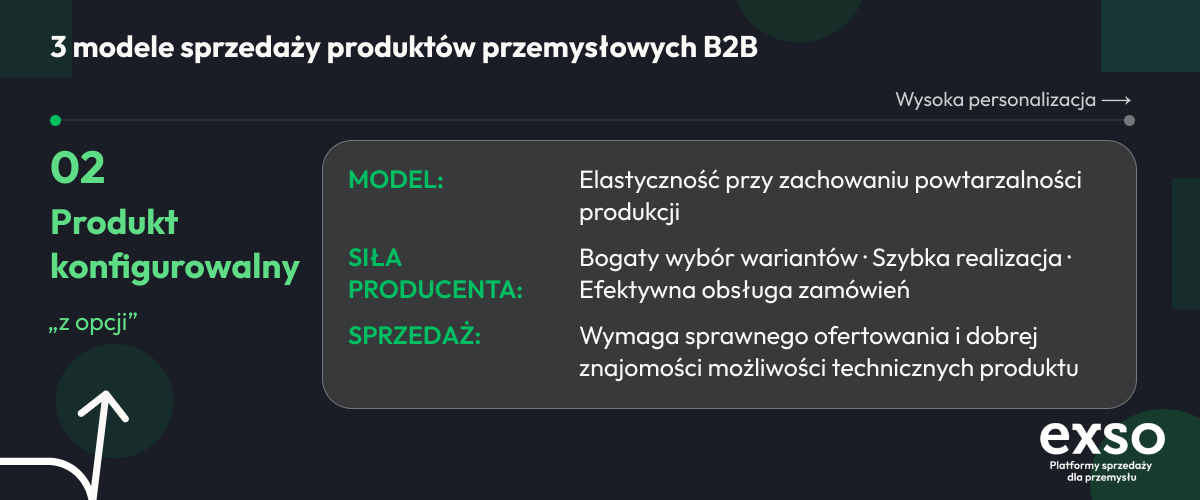
This type of product (🧩 Assemble-to-Order/Configure-to-Order, ATO/CTO) is made from standard components—but in a combination tailored to a specific customer. It can be a modular design, a parametric layout, a hybrid design, or another type—depending on the industry and the manufacturer’s philosophy. There is one common denominator: ready-made components, various configurations, and a product tailored to the order.
The second model is based on flexibility while maintaining production consistency. Every order is different—but it isn’t designed from scratch. The manufacturer’s strength here lies in the wide range of options and efficient quoting. The challenge is maintaining order amid a growing number of combinations and quickly converting specifications into a quote.
Examples: flail mowers customized for specific tractor models and cutting widths, control cabinets assembled from components, conveyor belt systems, and industrial windows and doors.
Type 3 - Product under development
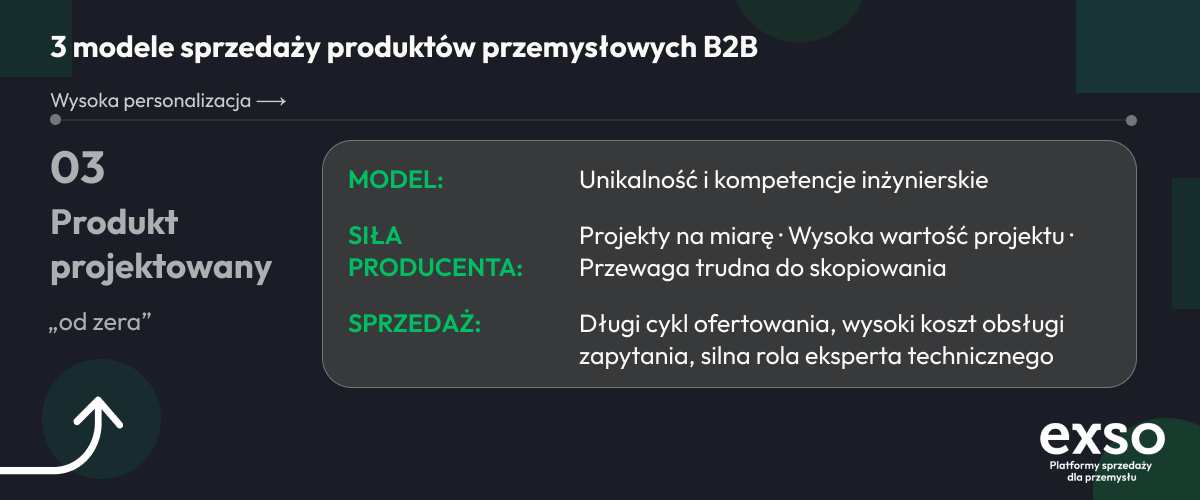
A product of this type (🛠 Engineer-to-Order, ETO) is built from scratch for each order. The starting point is the customer’s requirements—and it is only on this basis that the documentation, design, and solution are developed. There are no off-the-shelf modules or fixed options to choose from.
The third model is based on uniqueness and deep engineering expertise. Each order is treated as a separate project. The manufacturer’s strengths here lie in its technical knowledge and ability to implement custom solutions. The trade-off is a long lead time for preparing quotes and high costs associated with handling each inquiry.
Examples: production lines designed to meet a plant’s specifications, custom-built special-purpose machines, industrial buildings and shelters, prototypes, and test equipment.
Different sales tools for each product type
The sales approach stems directly from the nature of the product—and the same applies to tools. Each of the three types has its own business value and its own place in the market—and each follows a different logic when it comes to customer service.
- Standard products are sold through catalogs and fixed price lists. Sales of these types of products are naturally supported by a B2B online store, an ordering platform, and automated logistics processes.
- Configurable products are complex enough that manual quoting is costly, and repetitive enough that the process can be streamlined. The natural tool for this type of product is CPQ technology—a configurator integrated with automated pricing and documentation.
- Custom-designed products require a personal consultation and the designer’s involvement for each inquiry. The natural tools for this are PLM systems, engineering project management, and dedicated quoting processes (and sometimes CPQ as well).
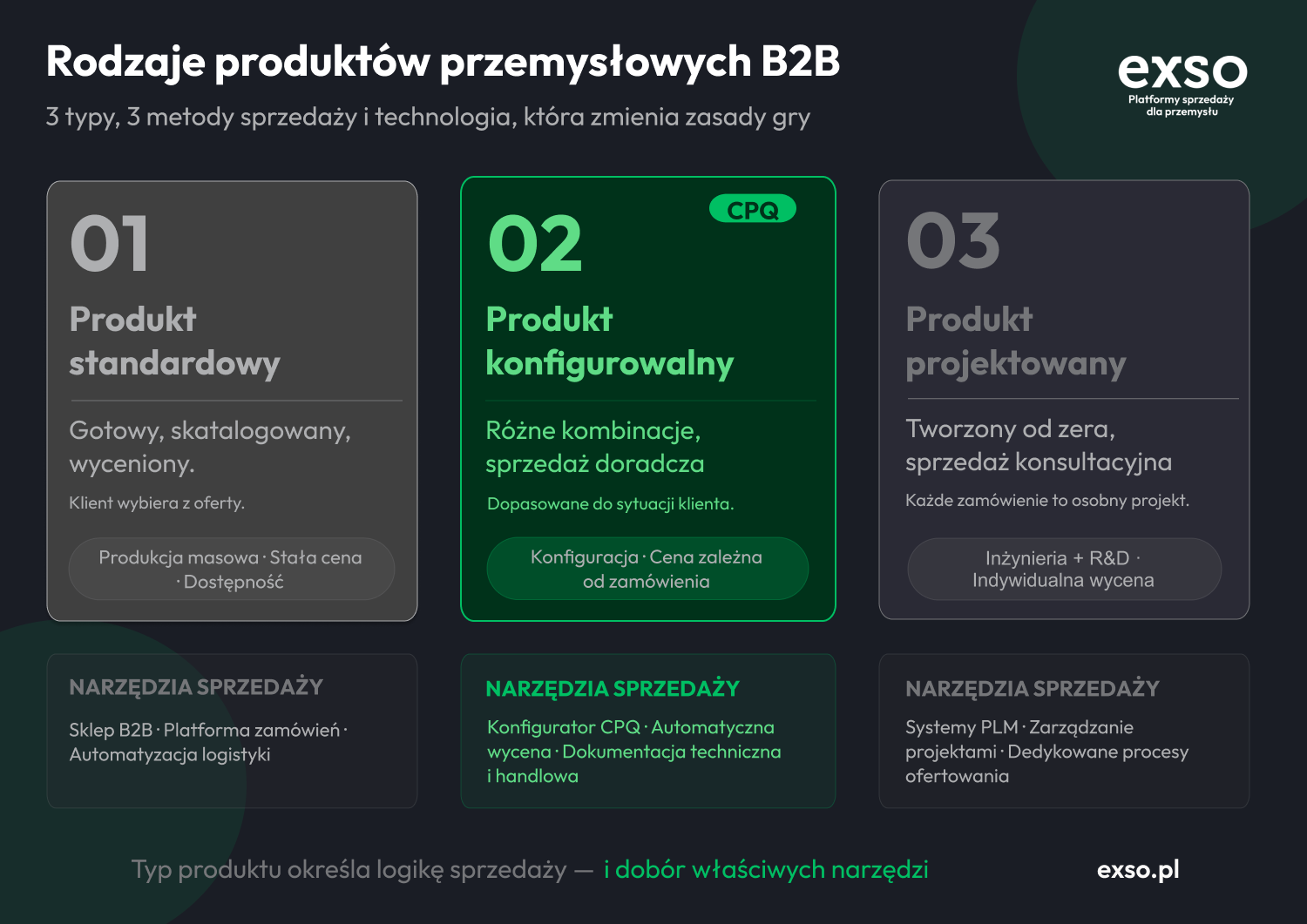
Of the three types, manufacturers of customizable products benefit the most from modern sales tools. This type of product deserves special attention.
What slows down sales of configurable products?
Regardless of the industry, the list of challenges is usually similar:
- It takes too long to prepare a quote—the sales representative has to involve the technical department whenever there are inquiries.
- Configuration errors are detected too late—invalid parameter combinations may not be detected until the production stage.
- Technical knowledge is scattered and difficult to convey—which slows down the onboarding of salespeople and partners.
- It is difficult for dealers and partners to scale up sales—because every new channel requires the transfer of complex product knowledge.
These aren’t organizational issues. They’re structural challenges stemming from the nature of configurable products —and that’s exactly what CPQ (“Configure, Price, Quote”) systems are designed to address .
Configurable Products and CPQ—A Natural Synergy for Better Sales
The CPQ configurator automates the process of preparing quotes for complex products: from selecting parameters and components, through price calculation, to generating technical and sales documentation. The entire process is based on predefined product rules, and every quote generated is technically accurate and complete, even without input from the technical department.
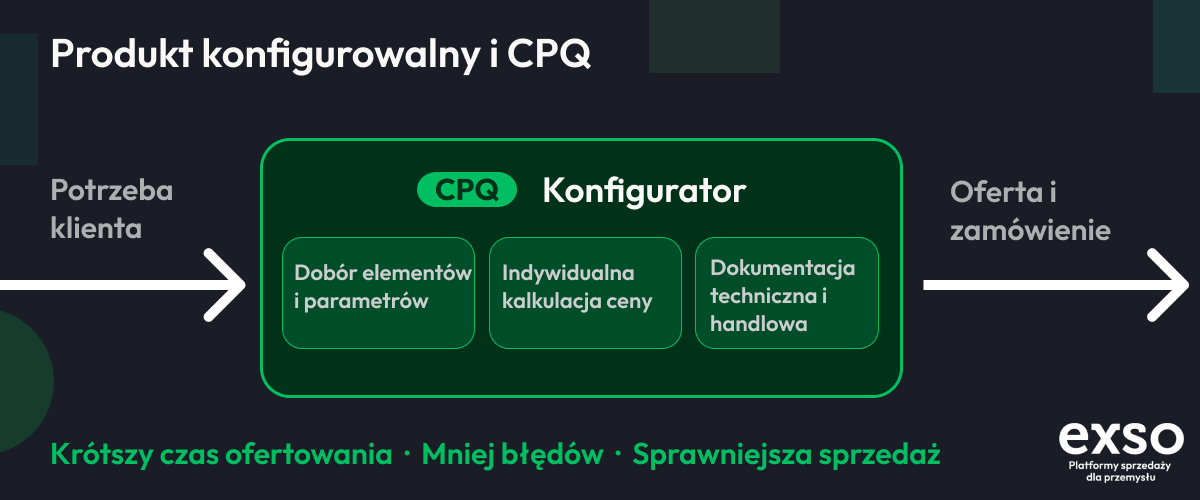
Configurable products and CPQ are a natural fit. The configurator is designed specifically for products that have many variants and rules:
- Only valid combinations—any configuration can be manufactured.
- Pricing by the minute, not by the day—changes to settings are immediately reflected in the current price.
- A seamless transition from quotation to production—the approved configuration is sent directly to the ERP and production systems.
- Complete documentation with no extra work—specifications, drawings, and sales documents are generated automatically based on the selected configuration.
What other benefits do product configurators offer companies during the quoting process?
Summary: Start with the product—that’s where the sales strategy comes from
Each product type has its own production logic. This determines the appropriate sales strategy and tools.
- Standard products are sold through catalogs, price lists, and efficient logistics. Naturally, this is supported by a B2B online store, an ordering platform, and automated logistics processes.
- A configurable product consists of components selected for each order, but it is not designed from scratch. It requires tools that enable efficient management of variants and quick responses to inquiries. CPQ technology—a configurator integrated with automated pricing and documentation—is the best solution for this.
- Custom-designed products require close collaboration with the customer, a lengthy quoting process, and robust engineering support for every inquiry. PLM systems, engineering project management, and dedicated quoting processes are well-suited for this. In some cases, CPQ technology can also support this type of project—when repeatable components or modules allow for structuring part of the quoting process.
Understanding which category your product falls into is the starting point for strategically developing your sales process and increasing its effectiveness.

For over 17 years, EXSO has been developing B2B platforms with configurators for large and medium-sized industrial manufacturers. We streamline the quoting and sales processes primarily for configurable products—such as machines, HVAC systems, and other complex industrial equipment.
Wondering if CPQ is right for your production model? Schedule a free consultation
Frequently Asked Questions
1. What are the three types of B2B products in the industry?
The classic classification in the field of operations and supply chain distinguishes three models of industrial products: standard (Make-to-Stock, MTS), configurable (Assemble-to-Order/Configure-to-Order, ATO/CTO), and engineered (Engineer-to-Order, ETO). Each type follows a different logic in terms of production, sales, and tools.
2. What is a configurable product?
A configurable product is assembled from standardized components selected to meet the specific requirements of an order —using a modular, parametric, or hybrid approach. Every order is different, but the product is not designed from scratch. Examples: flail mowers, trailers and semi-trailers, cranes, industrial elevators, control cabinets, conveyor systems.
3. Why are configurable products the hardest to price?
A configurable product combines flexibility with repeatability —which makes manual quoting costly and error-prone. Sales representatives must involve the technical department, product knowledge is difficult to convey, and scaling sales through partners and dealers requires transferring complex knowledge to each new channel.
4. What is a CPQ system, and who is it intended for?
CPQ (Configure, Price, Quote) is a category of systems that automate the process of preparing quotes for complex products —from configuration and pricing to technical and sales documentation.
It works best for companies that offer customizable products, where there are many variants and sales are handled by multiple sales representatives or partners.
It also supports custom-designed products—where recurring elements allow for the structuring of part of the quoting process.
5. What sales tools are best suited for each type of product?
- The standard product is supported by: a B2B online store, an ordering platform, and logistics automation.
- Configurable product – CPQ configurator with automatic pricing and documentation.
- Product design—PLM systems, engineering project management, and dedicated quoting processes. CPQ technology can also support this type of product when there are recurring components or parameter logic.